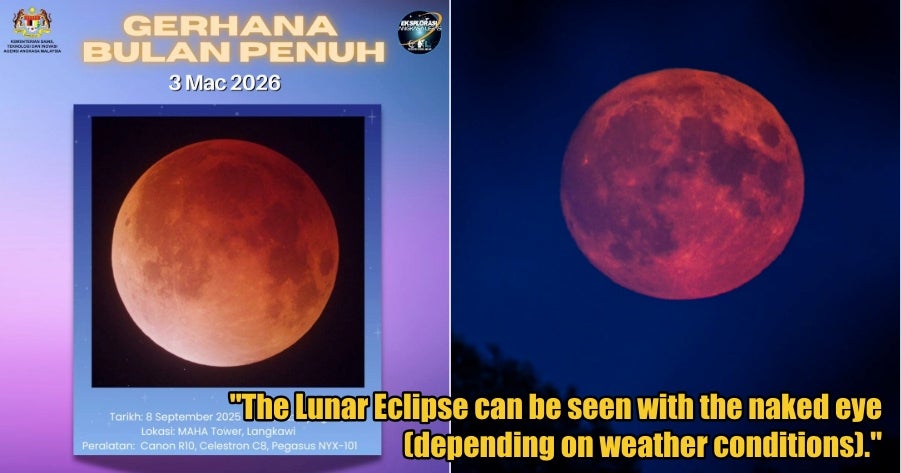
A Total Lunar Eclipse will take place tonight (3 March), during which the Moon will move completely into the Earth’s shadow, causing it to appear red or orange in colour.
The Malaysian Space Agency (MYSA) took to its Facebook page to share that this Total Lunar Eclipse will be the only one in 2026—the next will not occur until December 2028. The agency also provided further details regarding the phenomenon.
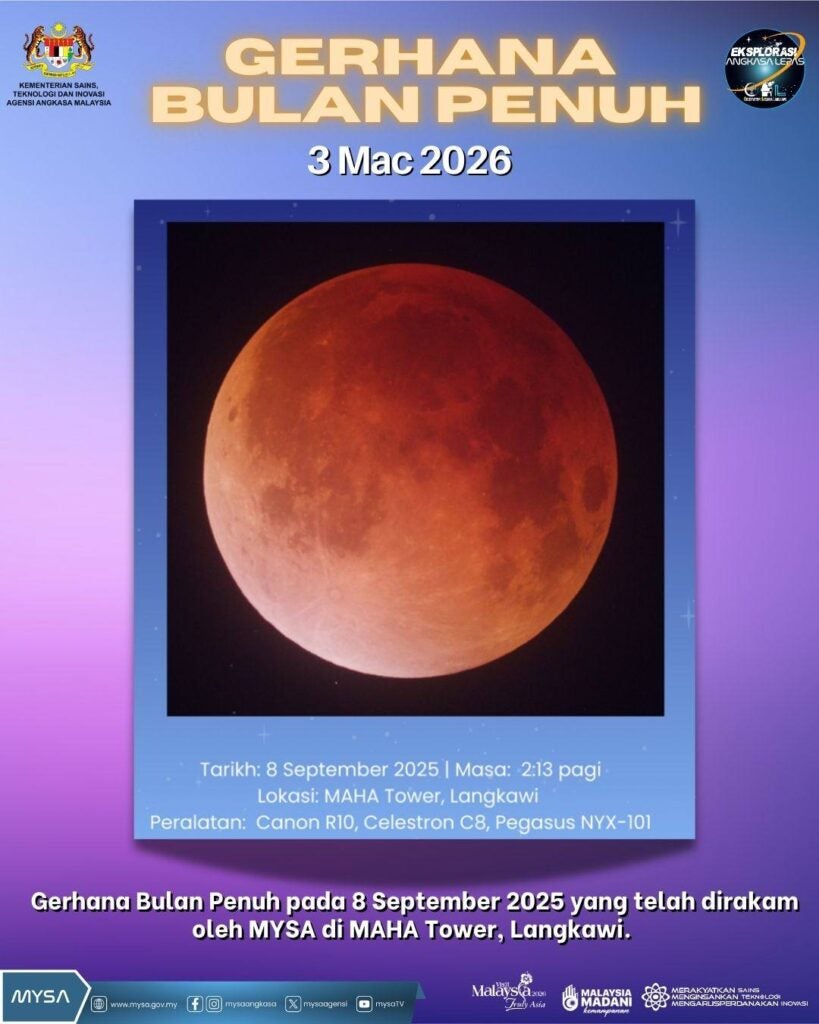
“A Lunar Eclipse occurs when the Earth is between the Sun and the Moon, until the Earth’s shadow covers the entire surface of the Moon,” MYSA wrote.
“This phenomenon causes the Moon to appear reddish. This Total Eclipse can be witnessed in East Asia, Australia, the Pacific Ocean, North America, and Central America. In Central Asia and most of South America, only a Partial Lunar Eclipse will occur.”
Eclipse timeline
The Partial Phase Lunar Eclipse (U1) will begin at 5:50 PM and then enter the Full Phase (U2) at 7:04 PM, with the peak of the Eclipse (GE) at 7:33 PM.
The Full Phase will then end at 8:02 PM and enter the Partial Phase (U3) again until 9:17 PM.
How to witness this phenomenon
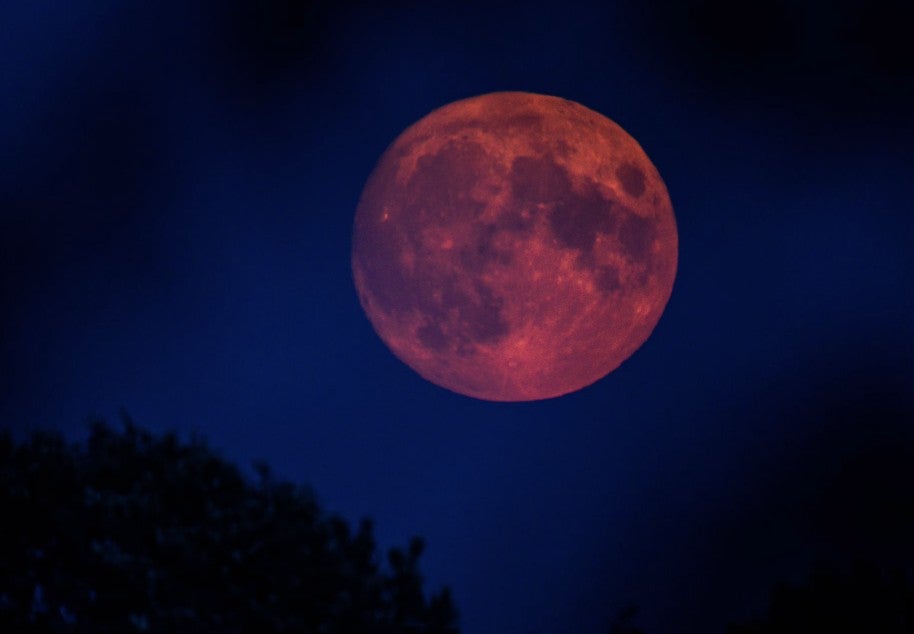
MYSA explained that for most states in Peninsular Malaysia, the Moon will rise during its full phase and may be difficult to see, as the twilight sky will still be relatively bright.
In Kuala Lumpur, the Moon will be only 2° above the eastern horizon at the peak of the eclipse. Conversely, those in Sabah and Sarawak have a better chance of observing the event, as the Moon will rise earlier and reach a higher angle in the sky.
“The Total Eclipse duration is approximately 5 hours and 39 minutes, while the full phase will last almost 58 minutes. The Lunar Eclipse can be seen with the naked eye, depending on weather conditions. However, the use of binoculars or a telescope will help to view this phenomenon more clearly,” the agency added.
What do you think about this? Feel free to share your thoughts in the comment section.