[TEST] Thirdhand Smoke: The Awful Smell, the Ugly Colour, and the Real Harms

Ever experienced walking into a room and the first thing that greets you is the stench that immediately indicates the presence of indoor smoking activities in the place? The stale odour of tobacco smoke.
What is Thirdhand Smoke?

One of the many unappealing physical attributes that smoking brings to the table, especially if done indoors, is the smell that it leaves on the surfaces of our furniture, fabrics, and even clothes. This stale odour is known as thirdhand smoke, a term that refers to a sticky chemical residue made up of pollutants that are released when tobacco is smoked. Not only does it leave a strong smell even after months the smoking has stopped, but it also turns these surfaces yellowish over time.
The actual detriment posed by thirdhand smoke
In addition to impacting the outward appearance and fragrance of our surroundings, the most concerning aspect of thirdhand smoke lies in its persistent harm to those in proximity long after the act of smoking has concluded. Based on a study conducted in 2010, the compounds generated from tobacco combustion, encompassing not just nicotine, but also hazardous substances like formaldehyde, naphthalene, and carcinogens, adhere to surfaces in our environment. Furthermore, the challenges extend beyond simple cleaning efforts, as these carcinogenic elements endure, even hours or days following the dissipation of visible cigarette smoke.
A team of researchers at Yale University, led by Drew R. Gentner, an Associate Professor of Chemical & Environmental Engineering, found scientific proof that these hazardous compounds can also be carried by people, from the smoke that clings to their bodies and clothes, and then released into non-smoking environments.
People are substantial carriers of third-hand smoke contaminants to other environments. In the Yale study, Assoc Prof Drew R. Gentner said this:
“The idea that someone is protected from the potential health effects of cigarette smoke because they’re not directly exposed to second-hand smoke is not the case.”
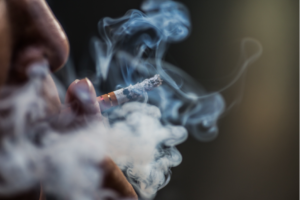
Thirdhand smoke exerts its impact on both smokers and non-smokers alike. Smokers inadvertently subject themselves to prolonged exposure, as the harmful residues from tobacco combustion adhere to their skin, clothing, and personal belongings. This continuous contact with residual toxins may heighten the risk of smoking-related diseases, extending the health consequences beyond the act of smoking itself. Non-smokers, on the other hand, are unwittingly exposed to these lingering toxins in shared spaces, putting them at risk of inhaling harmful substances.
The insidious nature of thirdhand smoke underscores the importance of awareness and comprehensive strategies so that we can take precautions and steps to reduce the harm that comes with the burning of tobacco such as smoking-related diseases.
Alternatives as a step towards a smoke-free future
According to American Lung Association, when a cigarette is burned, it releases more than 7,000 chemicals of which at least 69 of these chemicals are known to be cancerous while many are toxic and harmful. Because these harmful substances are produced during the act of burning tobacco, an obvious way to reduce the harms behind tobacco consumption is to eliminate the process of burning altogether. But how can that be achieved?
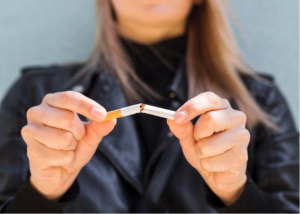
Alternatives such as Heated Tobacco Products (HTP) in particular, heats the tobacco instead of burning it. Without burning involved, it does not produce smoke that carries all the poisonous chemical substances. Instead, HTPs released Tobacco aerosol which is notably less harmful because aerosols consist of liquid particles formed from water and glycerine and it also does not generate carbon-based solid particles.
A peer-reviewed scientific research conducted by a group of scientists at PMI indicates that after heated tobacco products (HTPs) became popular in the Japanese market from 2013 to 2020, a significant decline in hospitalisation rates in Japan for chronic obstructive pulmonary disease (COPD), and ischemic heart disease (IHD) was seen.
“The totality of the evidence from our robust science shows that switching to IQOS, our most advanced heated tobacco product, is a better choice for smokers than continuing to smoke cigarettes, however, cessation remains the best choice.”
– Dr Gizelle Baker, Director of Scientific Engagement of Philip Morris International.
There are other smoke-free alternatives like e-cigarettes, snus and nicotine pouches, heated tobacco products are also proven to be less harmful than cigarettes. While the smoke-free alternatives are not risk-free and still carry nicotine, they are still better for smokers than continuing to use cigarettes. After all, they do not burn hence, no smoke is released which then reduces on average 95% harmful and potentially harmful chemicals. Ultimately, the ideal solution is for all smokers to quit smoking.
Also read: Nicotine is Not the Root of All Evil? Here’s Why There’s More to it Than it Seems



M’sians Outraged as Kelantan Store Owner ‘Only’ Jailed 2 Weeks for Molesting Elderly Customer During Ramadan
A shocking incident took place in Mukim Pauh Sembilan, Bachok, Kelantan, during Ramadan, involving a customer of a grocery store...


“Bring them home!” – M’sians Fume Over 3 Local Elephants Being Sent to Japan Despite Govt Assurance
Many Malaysians recently voiced concerns about the welfare of three local elephants after news spread that they were being transported...


JPJ Officers Go Undercover as Passengers, Find Bus Driver Using Phone & Breaking Rules on JB-KL Journey
As Malaysians prepare for the busy Hari Raya Aidilfitri travel season, enforcement officers from the Johor Road Transport Department (JPJ)...


Motorcyclist Killed On The Spot by Falling Tree in Alor Setar, City Council Offers ‘Compassionate Aid’ to Family
Just yesterday (15 March), a man tragically died on the spot while another was injured after a tree fell on...


32yo M’sian Smashes PDRM Truck Window with a Hammer to Prove He Isn’t a “Snitch”, Gets Arrested
To prove a point, a 32-year-old man in Sarawak deliberately got himself arrested by the Royal Malaysian Police (PDRM). He...


Ex-Law Minister Slams PMX’s Decision to Grant Extra Raya Holiday, Says It’ll Cost Malaysia RM1 Billion
Former Law Minister Datuk Zaid Ibrahim has voiced his concerns following Prime Minister Datuk Seri Anwar Ibrahim’s announcement of an...


HR Ministry Encourages Employers to Grant Additional Raya Aidilfitri Leave
The Ministry of Human Resources (KESUMA) has encouraged employers to grant flexibility to employees regarding the implementation of an additional...


PDRM: Deceased 17yo Student Who Fled Police Was Avoiding Fines for Modified Motorcycle
In a recent incident, a 17-year-old Malaysian student named Liu Le Yao (transliteration) lost his life while attempting to evade...


M’sia’s Ringgit Was on Track for Its Best Year in a Decade Then the Iran War Changed Everything for Forex Markets
Malaysia entered 2026 with unusual strength in its currency story. The ringgit had been moving toward what many saw as...


redONE Mobile Strengthens Community Ecosystem with more than RM1.3 Million Given in Partner Rewards
redONE Mobile reaffirmed its role as The Community Telco at Star Nite 2026, its largest annual partner appreciation night, presenting...


MAGGI® Brings M’sian Communities Together With the Bubur Lambuk Tradition This Ramadan
Across Malaysia, Bubur Lambuk has long been a symbol of Ramadan — prepared in communal pots and shared in the...

M’sian Family’s Thai Holiday Ends in Tragedy, 2 Injured Children to Return Home with Mum’s Ashes by Ambulance

Politician Slams Hannah Yeoh, Claims She is ‘Shaming’ B40 PPR Residents by Revealing RM26 Million Arrears

3yo Malay Boy Falls Ill from Missing His Indian Caregivers, Recovers After Reunion with ‘Amma’ & ‘Appa’
Ex-Law Minister Slams PMX’s Decision to Grant Extra Raya Holiday, Says It’ll Cost Malaysia RM1 Billion