
Did you know that the Malaysian judicial system offers a simplified and cost-effective legal process to resolve money disputes without the need for lawyers? Called the ‘Small Claims Court’, it’s a specific kind of court that hears cases between an individual plaintiff (the person who initiated legal action) and a defendant (the person or entity responding to the claim) where the amount claimed doesn’t exceed RM5,000.
For example, if a friend owes you money and refuses to pay, or a company refuses to pay for work that you’ve done, you can drag them to the Small Claims Court to compel them to settle the amount due, should it be RM5,000 or below.

For illustration purposes
What’s unique about the Small Claims Court, though, is that both parties must be self-represented during the hearing. Hence, you don’t need a lawyer or pay any exorbitant legal fees when filing a claim.
So, how does the Small Claims Court operate, and how do you file a case for any applicable grievances you have? Well, read on to find out.
Small Claims Court and its procedures

For illustration purposes
Speaking to WORLD OF BUZZ, Nik Nur Aisyah, a partner at Kuala Lumpur-based law firm ADIL Legal, explained that the Small Claims Court is an alternative to the regular court system that’s meant to avoid the need for lengthy and expensive lawsuits. Therefore, it makes justice more accessible and affordable for the public.
She added that in a Small Claims Court hearing, the case will be heard and decided by a Magistrate, with the procedures established under Order 93 of the Rules of Court 2012.
“In a Small Claims Court hearing, neither the plaintiff nor the defendant is allowed to be represented by legal counsel, except if the defendant is required by law to be represented by an authorised person,” Aisyah noted.

For illustration purposes
Additionally, the Small Claims Court presides over several types of civil claims for remedies, damages or compensation, which include but are not limited to:
- Loans
- Contract dispute
- Property or motor vehicle damage
- Personal injury claims
During a Small Claims Court hearing, the plaintiff must prove their claim against the defendant by producing witnesses and tendering documentary evidence. Accordingly, the defendant can also file their defence and any counterclaim, if any, in response.
Aisyah further elaborated that while neither party can be represented by a lawyer, they can still seek legal advice from legal professionals when pursuing or defending a small claim. However, they are strictly required to be self-represented during the hearing.
Furthermore, both parties can opt for a settlement during a hearing. Should this option be taken, the Magistrate may direct parties to enter into a consent judgment, which is a decision made with the consent of all the parties.
At the end of the hearing, the Magistrate will make their decision to either allow or dismiss the claim. Most importantly, the Magistrate’s judgment is final and neither party can appeal to a higher court.
The Small Claims Court may also award costs not more than RM100 to any party.
How to file a small claim case
For the plaintiff, filing a small claim case involves these steps:
- Go to the nearest Subordinate Court Registry and ask for the Small Claim form, i.e. Writ in Form 198
- Prepare 4 copies and ensure that the form and claim are duly completed
- Submit the completed form to the Subordinate Court’s Registry
- The court will inform you of the hearing date
- The plaintiff must serve the sealed Writ on the Defendant and file the Affidavit of Service. The fee is RM8.00
Meanwhile, for the defendant, the procedures are as follows:
- After being served with the sealed Form 198 from the plaintiff, go to the nearest Subordinate Court Registry and ask for the Small Claim form. i.e. defence and counterclaim (if any) in Form 199
- File your defence within 14 days from the date of the service. Failing to file a defence within 14 days from the date of service or failing to attend the small claim hearing, the judgment will be entered against you, and the plaintiff will get a judgment sum as claimed
Besides that, here are the relevant applicable fees when filing a small claim case:
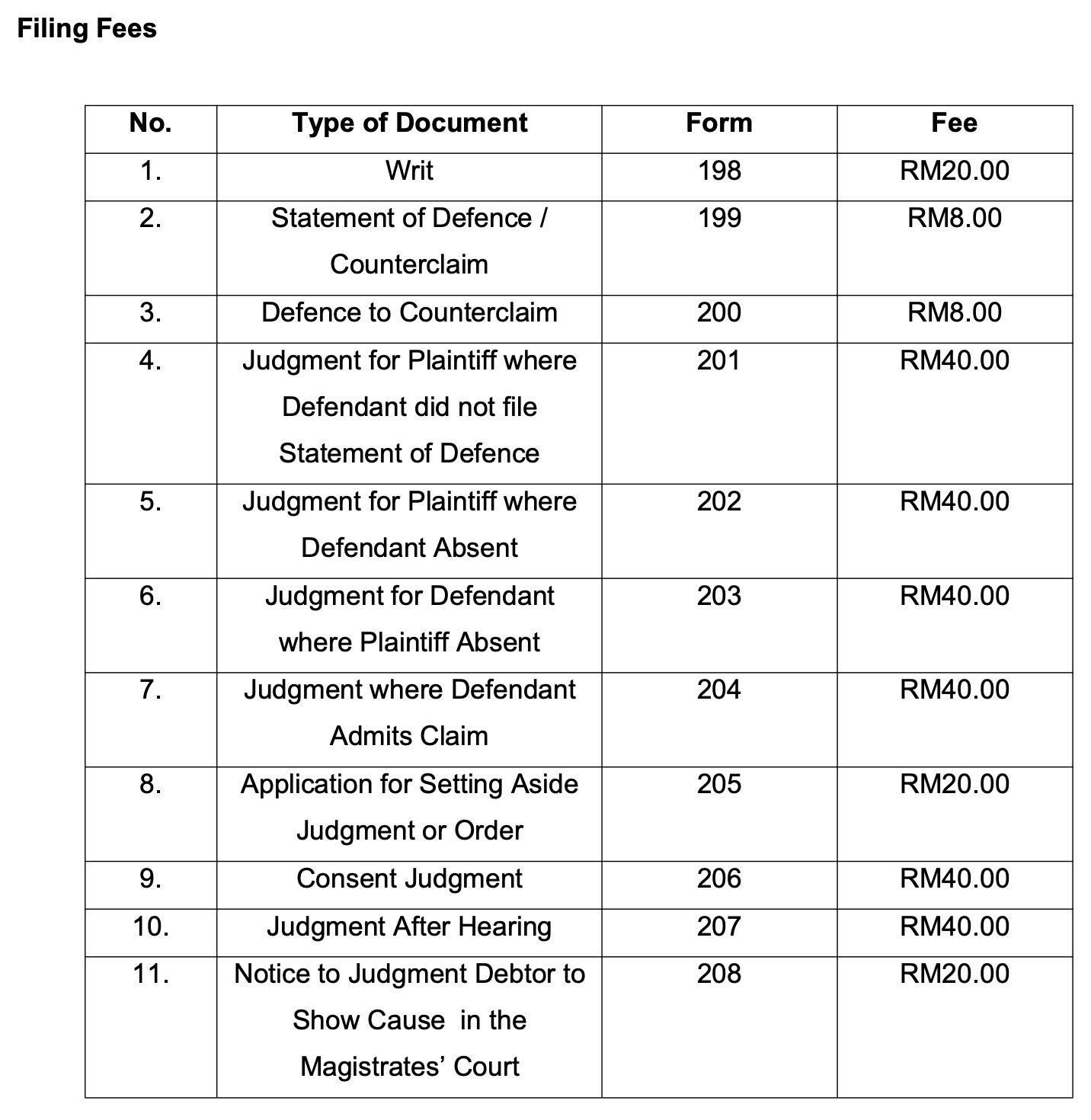
Image provided to wob
Small Claims Court judgments and their enforcement
Aisyah asserted that in a case where the defendant fails to file their defence within 14 days from the date of service, the Court may enter a judgment against the defendant, and vice versa for an absent plaintiff. This is as per Order 93 of the Rules of Court 2012.
Furthermore, the plaintiff must file a judgment and serve it personally on the defendant or by prepaid registered post. In the event the defendant is absent during the hearing, the Court may enter a judgment against them, and when the plaintiff is absent, judgment may be entered against them.
Besides that, the defendant has a right to apply for the judgment or order to be set aside by filing an Application for setting aside judgment or order.
Meanwhile, if the person against whom the judgment is made (“Judgment Debtor”) has not complied with the said judgment, the Court may, after receiving a notice to show cause from the winning party, give orders to:
- Order a writ of seizure and sale to the Judgment Debtor
- Allow the Judgment Debtor time to settle the judgment debt or pay the debt by instalments
- Order the Judgment Debtor to be committed to prison

For illustration purposes
So, what do you guys think of the Small Claims Court and its procedures? Do share your thoughts with us in the comments!