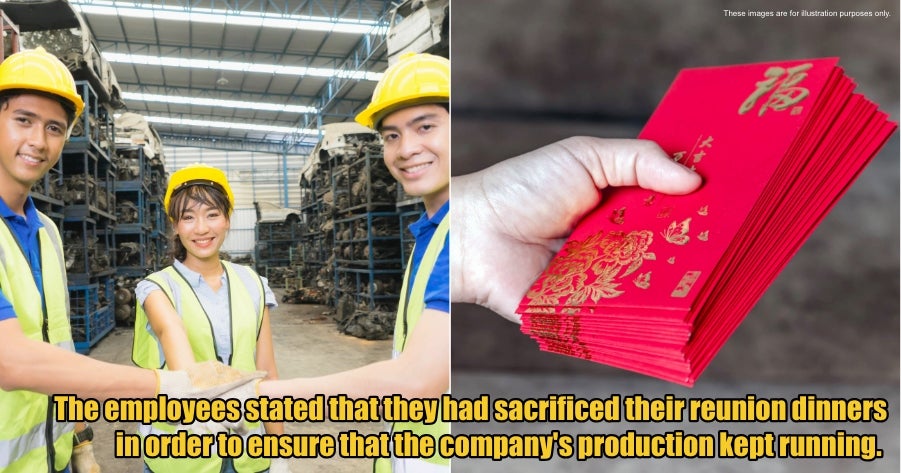
As we gallop into the Year of the Horse this Chinese New Year (CNY), the tradition of giving Ang Pow remains as timeless as ever. These red packets have become such a cultural staple that they have even crossed boundaries, inspiring the green ‘Raya’ envelopes exchanged during Hari Raya Aidilfitri.
Meanwhile, in the corporate world, many employers, especially those within the Chinese community, distribute Ang Pows as a symbol of gratitude and shared prosperity. It is a gesture that cements the bond between the employer and the team.

For illustration purposes
But what happens when a tradition spanning decades is suddenly halted?
This is exactly what happened to the employees of Tasek Corporation Berhad, a major cement manufacturer in Ipoh, Perak. In 2022, after the company abruptly stopped providing Ang Pow for overtime work during CNY, the workers, represented by Kesatuan Pekerja-Pekerja Perusahaan Simen Semenanjung Malaysia (the Union), took the company to court.
Read on to learn more about this landmark Industrial Court case:
Kesatuan Pekerja-Pekerja Perusahaan Simen Semenanjung Malaysia v Tasek Corporation Bhd [2025] ILJU 60
Speaking to WORLD OF BUZZ, Mohd Irzan Iswatt, a partner at Kuala Lumpur-based law firm ADIL Legal, elaborated on the case. He revealed that because cement kilns and production lines require continuous operation, the plant runs 24/7, even on major public holidays like CNY.
“Following the CNY period in 2022, the Union raised a grievance alleging that the company had failed to pay Ang Pow to employees who performed overtime work during the festivities,” he added.
The Union’s arguments
According to Iswatt, the Union informed the Industrial Court that, in the 1960s, the plant was predominantly staffed by Chinese employees. To encourage staff to work during the festive period, a special Ang Pow payment was introduced. Since then, it has been the company’s traditional practice to pay this to those working overtime on CNY Eve.
The Union argued that employees sacrifice their reunion dinner, the most significant event in the lunar calendar, to ensure uninterrupted productivity. They contended that the payment was an existing benefit and that it was unfair to withdraw it unilaterally.
The Union further argued that:
- A company document titled ‘Special Ang Pow Payment for Working During Chinese New Year’ from the 1960s constituted a binding agreement for the special Ang Pow
- There were reasonable expectations for the Ang Pow, as the company is bound by its prior conduct
- Taking the benefit away would disrupt industrial harmony and is an act of victimisation that uprooted the livelihood of employees.
The company’s arguments
This image is for illustration purposes only.
In response, the company refuted the Union’s claims, stating they were unfounded. They argued in court that:
- The Ang Pows were not a contractual obligation
- The payments were purely gratuitous rather than a legal right
- The ‘Special Ang Pow Payment for Working During Chinese New Year’ documentation only showed calculations and the history of payments
- Management held the prerogative right to waive, withdraw, or discontinue the Ang Pow payment at any time
The Industrial Court’s decision

This image is for illustration purposes only.
Ultimately, the court sided with the Union in a 2:1 majority decision. They balanced the company’s discretionary rights against the substantial merits of the case.
Iswatt explained, “The Court reaffirmed that benefits like bonuses and Ang Pows are generally at the absolute discretion of the company. It ruled that a company does not violate employment terms when exercising its prerogative to discontinue a benefit that is not legally mandatory.”
However, despite the lack of a contractual mandate, the court took into account the hard work of the employees to help the company thrive as a leader in the industry, as well as the festive spirit of the celebration.
“To ensure industrial harmony, the court found it ‘coincide and appropriate’ for the Company to pay the special Ang Pow for the year 2022 as an expression of appreciation, concern, and gratitude,” Iswatt added.
Guided by Section 30(5) of the Industrial Relations Act 1967 to “act according to equity, good conscience and the substantial merits of the case without regard to technicalities and legal form,” the court held:
- The Union’s claim for the 2022 payment was allowed, but strictly subject to and limited to the year 2022 only
- The court explicitly clarified that, as a matter of sole discretion and prerogative, the Company has the right to, and may, discontinue this benefit in the future
Iswatt clarified that while this decision confirms that bonus payments are generally a matter of management discretion, it also establishes that such discretion is not absolute.
“Once management has defined clear terms and established specific goalposts for a bonus, they are expected to honour those commitments,” he stated.
What do you think about this? Feel free to share your thoughts in the comment section.