
If you’ve ever followed our news coverage on ongoing criminal cases in Malaysia, you’d likely come across the term ‘police bail’, especially if the case involves a suspect released by the police after being arrested. Take this case or this viral incident, for example.
With that in mind, many misconceptions are floating around about police bail, as it’s not something a majority of Malaysians are familiar with. Accordingly, what exactly is police bail, and how is it different from court bail? Who can be granted a police bail and under what circumstances?

For illustration purposes
To answer this, we’ve gotten in touch with a Malaysian legal professional to clear up any confusion, so read on to find out.
What is bail? How is police bail different from court bail?

For illustration purposes
Speaking to WORLD OF BUZZ, Luqman Mazlan, a partner at Kuala Lumpur-based law firm ADIL Legal, explained that bail is the temporary release of an accused person on personal bond where they have to surrender themselves to the bond by appearing at the date, time and place mentioned in the bond.
He added that there are two types of bail, police bail and court bail:
Police bail:
- Also referred to as “jamin mulut” in Malaysia
- It is granted when an investigation can’t be completed and may be given after an arrest and before being charged in Court
- Usually takes the form of a bond by the surety without securities being furnished
Court bail:
- The release of a person from the custody of the detaining authorities upon security given for their appearance in Court on an appointed date

For illustration purposes
Circumstances in which police bail can be granted

For illustration purposes
Going in-depth on police bail, Luqman elaborated that under Article 5(4) of the Federal Constitution, an arrested person is entitled to the right to bail upon arrest if they are not produced before the Magistrate within 24 hours.
The same right is also given to an arrested person under Section 28 of the Criminal Procedure Code (CPC).
Meanwhile, Section 29 of the CPC below prescribes that an arrested person shall only be released on his own bond or on bail or under the order in writing of a Magistrate or of a police officer not below the rank of Inspector.

Screenshot provided to wob
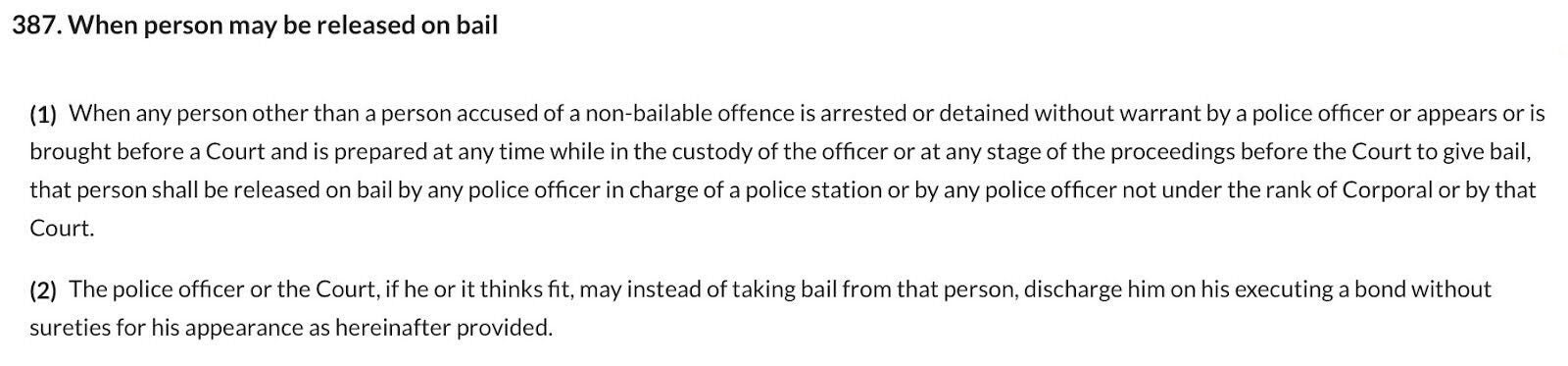
The general law on police bail is further established by Section 387(1) of the CPC, which prescribes that when an individual is arrested or detained without warrant by a police officer, and they are prepared to give bail, that individual shall be released on bail by the police officer in charge of a police station (OCS) or by any police officer not under the rank of corporal.
Furthermore, Section 387(2) of the CPC establishes that the arrested individual may even be discharged on the execution of their bond without sureties for their appearance.
Screenshot provided to wob
In other words, the aforementioned OCS or police officer not under the rank of corporal shall release the arrested person on bail or discharge them on executing a bond without sureties pending investigation. This is essentially what is meant by ‘police bail’.
However, Luqman emphasised that Section 387 of the CPC only applies to individuals who are accused of a bailable offence.
Bailable, non-bailable and unbailable offences

For illustration purposes
For context, there are three types of offences, namely bailable offences, non-bailable offences and unbailable offences:
Bailable offences
- Bail has to be offered as of right
- Examples of bailable offences are voluntarily causing hurt and cheating
Non-bailable offences
- There is discretion in granting bail
- Examples of non-bailable offences are rape, theft, infanticide and causing grievous hurt by dangerous weapons or means
Unbailable offences
- Offences punishable with death or life imprisonment
- Examples of unbailable offences include drug trafficking under the Dangerous Drugs Act 195, murder, or kidnapping under the Kidnapping Act 1961
Police bail can still be granted for non-bailable offences under certain circumstances
Despite the name, police bail can actually still be granted for non-bailable offences.
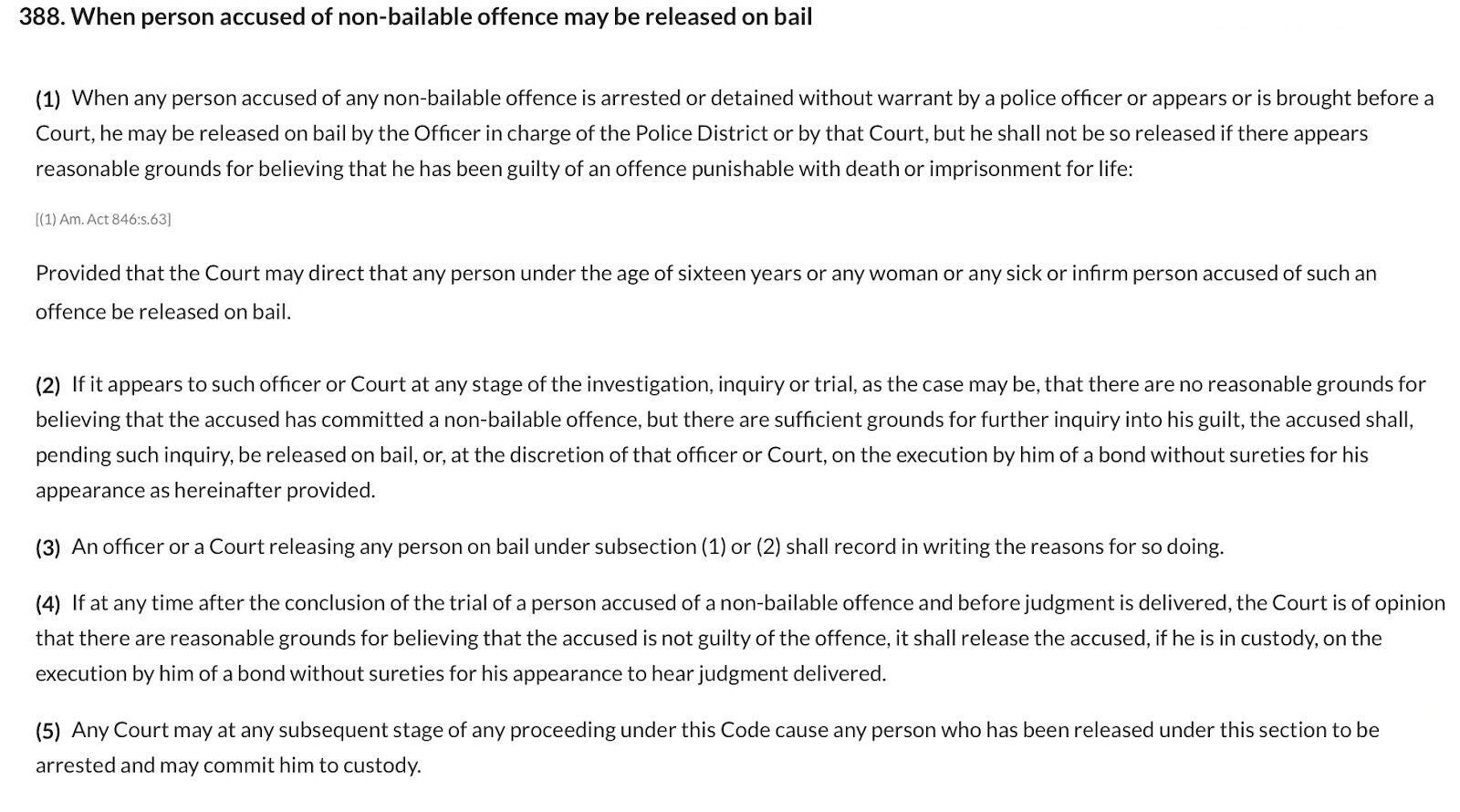
Luqman asserted that under Section 388 of the CPC, when a person accused of committing a non-bailable offence is arrested or detained without a warrant by a police officer, they may be released on bail by an officer in charge of the police district (OCPD).
However, the arrested person shall not be released if there are reasonable grounds for believing that they are guilty of an offence punishable with death or imprisonment for life.
Moreover, the provision also allows the OCPD to exercise their discretion to release the person on bail at any stage of the investigation, with a condition that they execute a bond without sureties to secure their attendance when required.
Additionally, the Court may also, at any subsequent stage of any proceeding under the CPC, cause any person who has been released under Section 388 to be arrested and may commit them to custody.
Screenshot provided to wob
So, what do you guys think about police bail in Malaysia and the procedures surrounding it? Do share your thoughts with us in the comments!