Hackers Behind Kluang LED Billboard Breach Finally Reveal Why They Did It
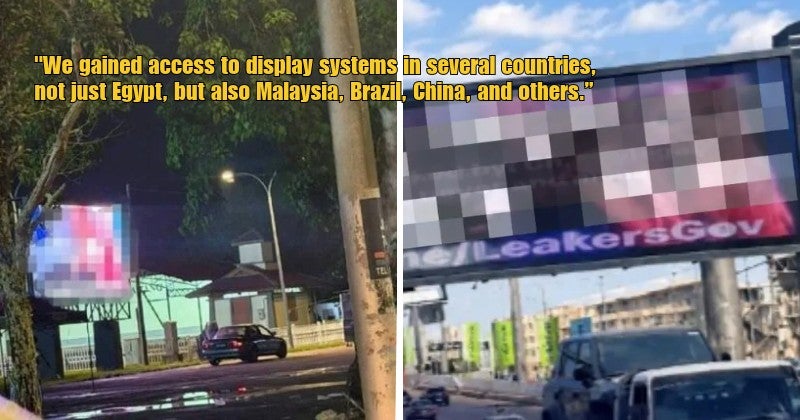
Following recent high-profile cyberattacks that saw public LED screens in Kluang, Johor, and Giza, Egypt, abruptly hijacked to broadcast explicit content, startling new details have emerged regarding how vulnerable digital billboards truly are worldwide.
The hacking collective responsible for the stunt, operating under the Telegram channel ‘Leakers$’, revealed to The Cairo Report that the breach was part of a widespread international software vulnerability affecting multiple countries simultaneously, including Malaysia, Egypt, China, and Brazil.
Automated scans uncovered thousands of exposed systems globally
According to The Cairo Report, the security breach first drew international headlines on 29 October 2026, when explicit footage was displayed on a massive electronic billboard along the busy 26 July Corridor in Giza, overlooking major traffic routes.
Videos quickly circulated online, forcing Egyptian authorities to suspend advertising displays and launch formal investigations. The affected billboard is operated by Arabian United, an Egyptian-Saudi joint venture involving United Media Services (UMS), a media conglomerate linked to Egypt’s General Intelligence Service, and Saudi-listed Arabian Contracting Services Co.
A representative of the hacker group claimed that the incident did not require complex hacking techniques or target Egypt individually. Instead, they exploited a flaw in software used to transmit content to digital displays.
“It was a genuine vulnerability in the software responsible for transmitting content to LED displays. After exploiting it, we gained access to display systems in several countries, not just Egypt, but also Malaysia, Brazil, China, and others.” the representative said, as reported by The Cairo Report.
According to the group, members used automated scanning tools over approximately two hours to identify thousands of exposed commercial systems that lacked basic online protection.
They clarified that its primary objective was to expose severe security failures rather than demand ransom payments or carry out ransomware attacks.
“Companies charge millions to build infrastructure across multiple countries and leave LED screens and billboard networks wide open on the internet without basic protection,
“It wasn’t nearly as complex an operation as many might imagine,” its representative told The Cairo Report.
Intelligence links and government response
The revelation that a major infrastructure operator with ties to state intelligence could be easily compromised has sparked intense scrutiny over cybersecurity standards in public advertising.
When questioned about how an intelligence-linked commercial network could fall victim to such a breach, the hacking group’s representative remarked:
“If infrastructure operated by a company linked to Egyptian intelligence can be compromised, it demonstrates that such connections do not necessarily translate into strong cybersecurity.”
Egypt’s Interior Ministry previously attributed the incident to the hacking of an unnamed international advertising company’s website, noting that identical footage appeared across screens internationally at the same time. While Arabian United immediately shut down the affected screen and pledged cooperation with authorities, the incident highlights a glaring regulatory blind spot.
Despite strict government oversight on billboard content, such as Egypt’s National Authority for the Regulation of Roadside Advertising, which enforces public morals and urban standards, formal cybersecurity audits and standardised protocols for remotely operated cloud networks remain largely undefined.
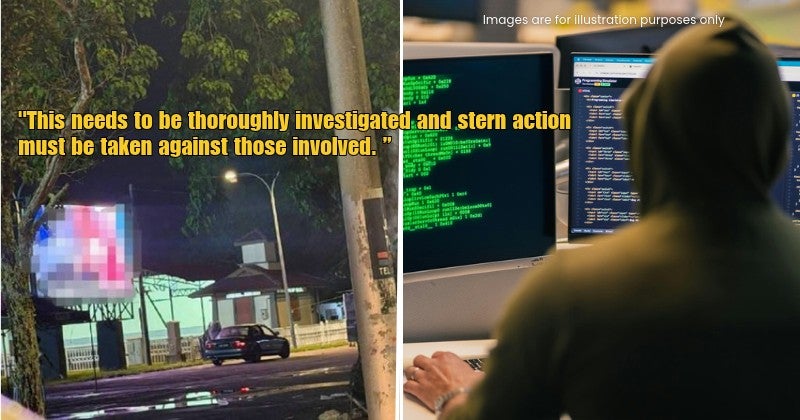
As authorities continue investigations locally and internationally, public infrastructure security remains a critical talking point for smart cities.
What are your thoughts on safeguarding public digital screens from cyber threats? Share your views in the comments below!
Also read: Not What You’d Expect on a Public Screen! Kluang LED Displays Hacked, Show Explicit Videos & Images
 secur